


Reviews 9

 Server Locations
Reviews 16
Server Locations
Reviews 15
Server Locations
Reviews 7
Server Locations
Reviews 6

Server Locations
Reviews 5
Server Locations
Reviews 5
Server Locations
Reviews 5
Server Locations
Reviews 5
Server Locations
Reviews 5
Server Locations
Reviews 5
Server Locations
Reviews 5
Server Locations
Reviews 5
Server Locations
Reviews 5
Server Locations
Reviews 5
Server Locations
Reviews 5
Server Locations
Reviews 5
Server Locations
Reviews 12
Server Locations
Reviews 15
Server Locations
Reviews 5
Server Locations
Reviews 6
Server Locations
At the beginning of the Internet, hosting or making any type of content available for some level of access, required knowledge and investment that was not available to most people and even some companies.

A server, a link, network infrastructure, a dedicated IP address, system licenses, and technical knowledge were required to integrate and make everything work. The cost of this was in the order of thousands!
Eventually, some free services appeared, with many limitations in relation to what could be hosted, with a performance that was often compromised by the free nature and the absence of technical support.
After several years, the requirements for hosting something are still the same, but accessibility in terms of cost is another. See in this article what is shared hosting and its advantages. Good reading!
Start of Shared Hosting
With a daily investment in the order of cents, a professional, a freelancer, a company, or even an individual, has his website, his e-mail accounts, applications, databases, all present on the Internet, 24 hours a day, 7 days a week. What has changed? The emergence of what the market knows as shared hosting and which represents the service consumed by 99% of all existing sites in the world!
About two decades ago, when the pioneers - true pioneers of the new technology - of the Internet began to implement the first services for large corporations, they identified that, often, all that infrastructure and investments made, were mostly idle, after all, at the time, the Internet was just crawling.
People did not even know the term and its use was very restricted. Then the idea came: why not "rent" part of that infrastructure that was not all used, for those who also had an interest in exploring the new possibilities that arose, but had neither the know-how nor the capital to do it?
Shared hosting had just been born, that is, two or more companies or users, using the same resources and thus sharing the necessary investment. And so, it was thanks to the idealized shared hosting model, that the commercial Internet was a success and spread globally, allowing it to develop to the point that we know today.
How does it work?
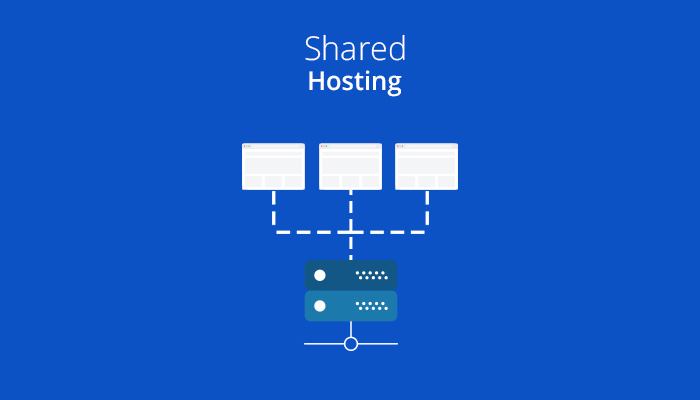
Basically, this model consists of creating accounts for each domain hosted on a server with a high computational capacity (high levels of processing, memory, and storage), in which all the services that a typical hosting usually offers are present: websites, email, FTP, databases, etc.
This server is inserted in infrastructure with several others, interconnected through local networks and from these to other external networks, using routers and switches.
Other details comprise everything that is necessary and that include firewalls, cooling systems, security, energy, all of which are accommodated in rooms with access control and under a strong surveillance and security scheme, ends up composing what is known as a data center.
A user hosted on a shared server has in his account all these services, in addition to others, which are used together with the other users.
In a similar way, this process can be compared to a resident of an apartment building, who shares everything the condominium offers (elevator, party room, courts, swimming pools, games room, etc).
In other words, hosting a domain on a shared basis means enjoying an immense range of services and infrastructure, which will make it possible to have a website, e-mail accounts, online applications, or what you imagine in terms of Web services, at a very low cost.
Usage control
As in the condominium analogy, on a shared server there are rules and limits for the use of common resources, which aim that all users have the availability of resources ( access to websites, sending and receiving e-mails, consultations with databases, etc.) and make equal use of it.
For that, systems are installed on a server that controls and limits the use by each account, and policies are established and disseminated so that everyone knows the service usage limits.
But why impose limits? Anyone who lives or has lived in an apartment building knows the inconvenience of using the elevator on a moving day. Only one working elevator, always full and with a long waiting time. The other, 100% occupied by the change owner.
If this happens on a shared server, that is, one of the users is consuming, for example, 50% of all the server's processing power, only the remaining 50% remains to be shared by all the other users, which may be little and lead to a slow website, just like the previous analogy. The result is, in addition to the delay in accessing the sites, delays, or even errors in querying the database, sending and receiving e-mail, to all other services.
That is why shared hosting has its limits, so that none of the services that make up the hosting is used in a very intense way or much above the average of other users, so as not to harm them, but also for sharing to be fair.
Cases in which Shared Hosting is more indicated
As we have already mentioned, a significant number of all existing sites are based on the shared hosting model, which has made it possible for virtually any person and company to have a website and services associated with it.
But even though it is the prevailing model, it is not always possible to host an Internet project in shared hosting plans. Projects that are already born with greater intentions are generally not suitable, or to meet the demands of large companies, which may even have modest institutional sites in terms of resources and size, but due to a large number of e-mail accounts and, consequently, traffic information, require more robust solutions.
So, here are the most common cases in which a shared hosting plan usually serves well enough:
Liberal professionals (dentists, doctors, lawyers, accountants, etc.) and all professional activity, in which the activity is carried out autonomously or even when a legal entity is constituted, but the corresponding business infrastructure is small
Small companies, which do not have large websites and which exceed a few hundred visits per day and a few dozen e-mail accounts
Individuals and freelancers, who generally have small websites, personal blogs and who use few email accounts
People and companies with little technical knowledge, who need a simple service in terms of use, but complete in resources that allow having efficiently what a hosting service can provide
Count on a range of resources that make administration simple, such as, for example, an automatic CMS installer, through which it is possible to create different types of websites, ranging from the traditional institutional website, through a blog and even a virtual store
Non-profit entities and organizations, which generally have limited resources of all kinds, but which, like any other, need to rely on the collection of resources that the Internet offers
Key features of Shared Hosting
When you are looking for a shared hosting service, it is important to keep in mind some aspects that differentiate each plan and each company. You do not need to be an expert on the subject, but some notions of the main characteristics that tend to be part of each plan and what to observe are adequate for you to make an appropriate and conscious choice.
Disk Space
This usually appears as the first and/or main point of each plan. Just like your personal computer or smartphone, where you need space to install applications, save photos, videos, documents, among all types of content you usually have.
In a hosting account, it is no different. Its website consists of several files of the programming language in which it was developed, with images, videos, PDFs, databases, configuration files, etc. All of this, added to the e-mails you receive, takes up space and this you must observe, know if it will be enough and according to your current and medium-term needs.
Traffic
Traffic is analogous to what you already know in terms of the mobile data in your phone plan. That is, with each access that your site has, each email sent or received, and each file sent or downloaded from the server, data is transferred, composing what is called traffic.
Email Accounts
This refers to the number of email accounts that can be created. Although there are unlimited plans that do not stipulate a limit for creating accounts, it is appropriate to remember that a large number of users, especially if they make intensive use of this service, can overload the environment, as well as occupying all the disk space. available in the plan. Therefore, it can sometimes be recommended to hire a service where this resource is scaled according to the needs of the company.
Domains and subdomains
Another point of differentiation between hosting plans is the number of domains and subdomains that can be created and hosted in one plan. It is something to be considered, when you have more than one registered domain, or even if you only have one, but plan to have a website, a blog, a forum, or some other type of website that may be linked to a subdomain, for example, store.mydomain.com.
Databases
Currently, it is impossible to think about the different types of websites that exist and any web application, that does not have a programming structure that depends on and is integrated with one or more databases. Therefore, the number of available databases must be at least equal to the number of domains and subdomains that you can have under the contracted plan.
Uptime
The uptime refers to the minimum time in percentage terms, the hosting provider ensures that services will be available over a month. Therefore, a service with 99.5% uptime, indicates that this is the minimum time that the website, e-mail, and other services will be accessible or in a complementary way, that at most there will be 0.5% of unavailability of services over a period of time one month.
Pre-installed apps
Usually called CMSs and which stands for Content Management System, they are nothing more than applications that allow you to create and manage websites for the most different purposes. Therefore, there are CMSs for creating a blog, an online store, a forum, and even a social network, if you want or need it.
Control panel
Website hosting services offer what is known as a control panel - and similarly to what you have on your computer - brings together a set of tools to control hosting. Through it, you create databases, e-mail accounts, view service usage statistics, access the CMS installer, among a series of services that integrate the hosting service.
Knowing which panel is used is also important in the event of a future and eventual change of company. There are, roughly speaking, hosting panels and there are those that are specifically created by a specialized company and are adopted by many companies. Whenever possible, choose the second option, as it makes it much easier when migrating.
Technical support
It is assumed that to a greater or lesser degree, even if everything works perfectly well in hosting, that at some point you have to resort to technical support, after all, there is always some doubt about the use of the resources of the contracted plan, especially because you are here, you should not be an expert on the subject.
Also pay attention to the service time, preparation, and cordiality of the employees who work in the support, as well as the service channels that are provided to receive assistance. When you need it most, it is important to have an efficient, agile, and available team.